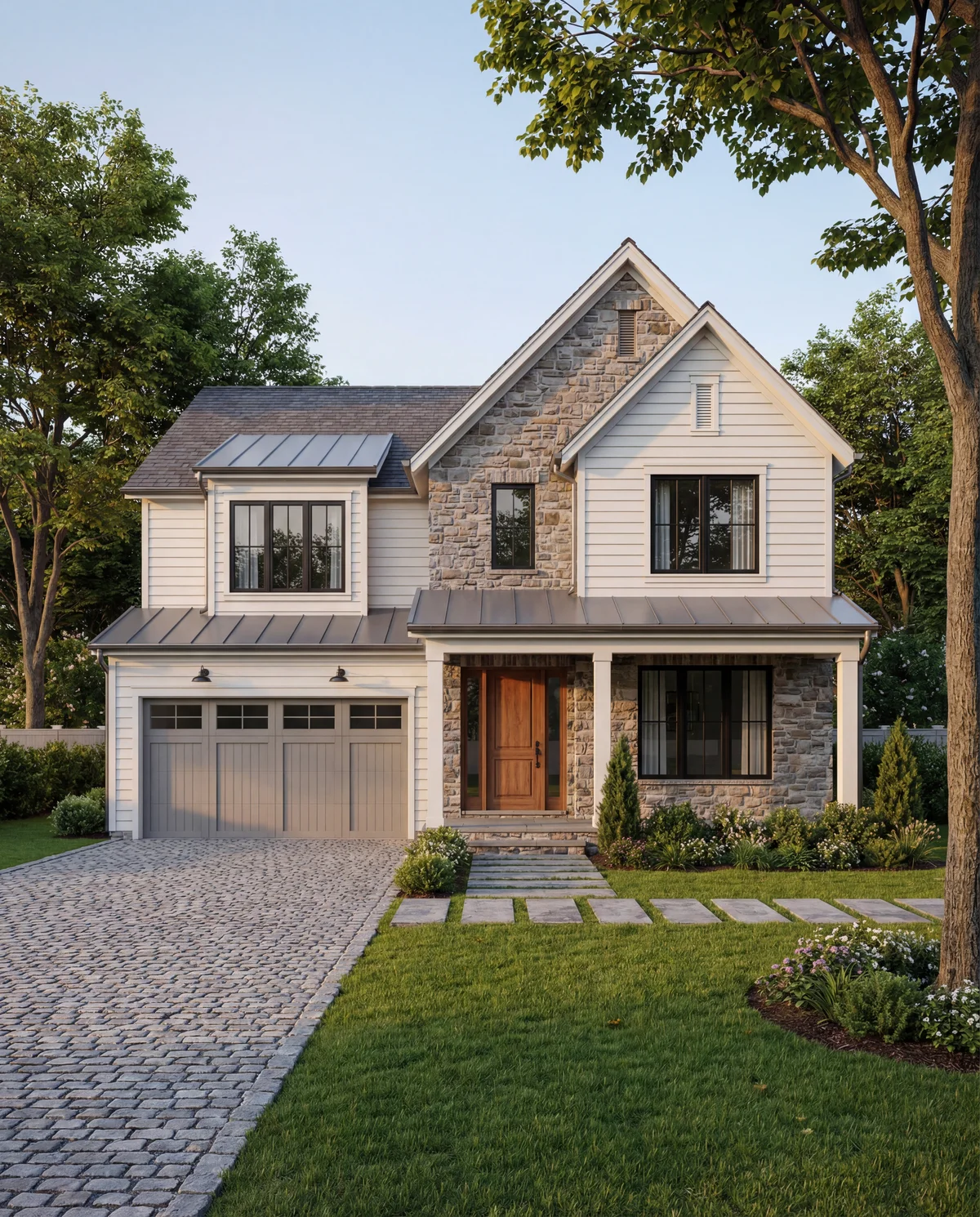
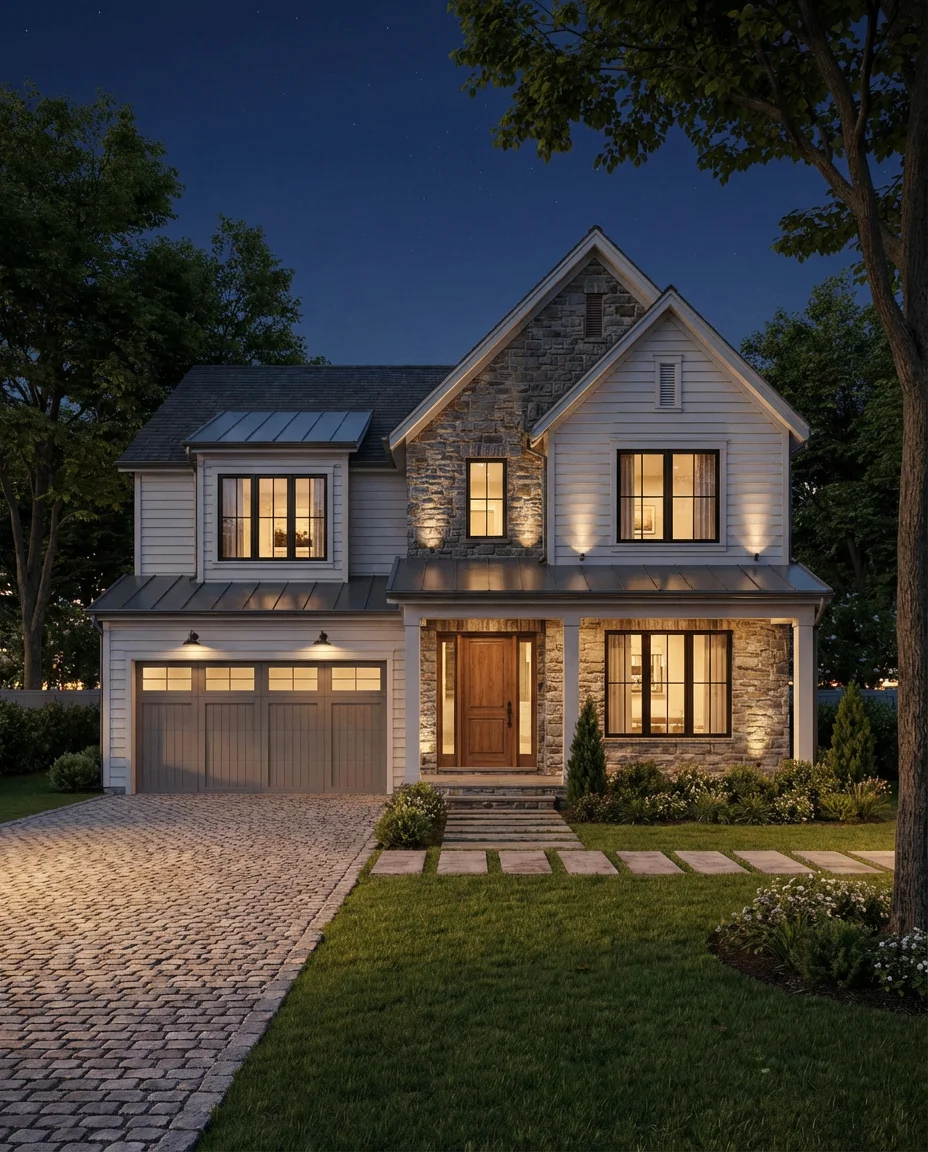
You can describe a facade lighting scheme in a specification and nobody will understand it. Show one night view and the conversation is over in five seconds.
Describe the fittings, not the mood
"Make it night" gets you a dark version of the same picture. Lighting designers get better results because they name sources, and so should you:
- Soffit downlights washing the facade from above — the effect visible across the stone in the image.
- A lit entrance. Either a pendant or wall lights flanking the door. This is where the eye goes first.
- Path and driveway lighting at low level, pooling rather than flooding.
- Uplighting on planting. Two or three specimen trees, not everything.
- Interior spill from specific rooms, with the curtains as they actually are.
Name the colour temperature too. Warm white, around 2700K, reads as domestic. Cool white reads as commercial, and a house lit at 4000K looks like a car park no matter how good the architecture is.
The three mistakes
1. Every window lit, equally. The single biggest tell. Real houses have some rooms lit and some dark, at different brightnesses and different colour temperatures. Say which rooms are on.
2. No sky. Full black removes the roofline. Keep the deep blue of late dusk so the building still has a silhouette and the context is readable.
3. Nothing lit outside. If only the windows glow, the building floats in tar. Ground the composition with path lights, a lit driveway or an uplit tree.
Use it as a lighting study
Because each variation is 4 credits ($0.35), you can produce four genuinely different schemes for the price of a sandwich: facade wash only, entrance-focused, landscape-led, everything. Put them side by side in front of a client and you will get a decision in one meeting rather than three.
Just keep the camera and the materials description identical across all four, or you will be comparing four buildings instead of four schemes.
The honest caveat
This is an image of a lighting scheme, not a photometric calculation. It shows intent beautifully and it proves nothing about lux levels, glare, spill onto a neighbour or compliance with a lighting condition. When those matter, it is a conversation-starter for the lighting consultant, not a substitute for one.
Common questions
Can I convert a daylight render to night without re-rendering?
Yes. The conversion keeps the building and the camera and changes the sky, the ambient level and the artificial light.
Why does my night render look fake?
Every window lit equally, no sky left in frame, or no exterior light so the building floats in black.
Should I use night or dusk?
Dusk, nearly always — a deep blue sky keeps the roofline readable.
Does this work for interiors too?
Yes, with the same discipline: vary the sources rather than lighting everything equally.
Try a night version of a render you already have: Exterior Lighting.